Playable Vectrex game
About 3-D Narrow Escape
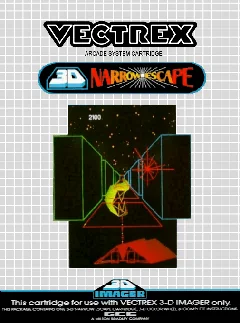
Pilot through a warlord’s moving fortress, collect fuel, shoot defenders, and experience Richard Moszkowski’s 1983 3-D Imager cartridge in a browser.
- Collection
- Games
- Classification
- Official library
- Catalog year
- 1983
- Programmed by
- Richard Moszkowski
- Designed by
- Jeff Corsiglia
- Publisher
- GCE / Milton Bradley
- Genre
- Rail shooter, 3-D action
- Players
- 1 player
- Research confidence
- verified
- ROM editions
- 1
- Browser controls
- Keyboard, joystick, or gamepad
Development and history
3-D Narrow Escape was one of the official 1983 Vectrex 3-D Imager releases. The Vectrex Game Database credits Richard Moszkowski as programmer, and Vectrex developer recollections credit Jeff Corsiglia with the design.
The premise sends the player through narrow, fast-moving corridors inside a hostile space fortress. The cartridge combined the Vectrex’s perspective-vector drawing with the Imager’s synchronized shutters and color wheel, making it an ambitious example of early consumer stereoscopic game design.
This page uses one stable canonical URL for the title and loads its embedded ROM directly into the emulator after the Vectrex BIOS is ready.
This title is associated with the Vectrex 3-D Imager library. Vectrexia simulates the wheel-motor timing, index sensor, and CA1 synchronization needed for the cartridge to progress without the physical headset, while a normal monitor still cannot reproduce the spinning color wheel or stereoscopic separation.
Gameplay and background
Steer through openings, avoid debris, collect fuel cells, and fire on defensive ships before confronting the warlord’s escape craft. The browser version preserves the cartridge logic and vector scene, while the original accessory-dependent stereoscopic effect is not reproduced by an ordinary monitor.
How to play in Vectrexia
- Move with the Arrow keys or WASD. Compatible controllers can use the left analog stick or D-pad.
- Vectrex buttons 1–4 map to Z, X, C, and V, and to the standard face buttons on most gamepads.
- Press a controller button after connecting it so the browser can expose the gamepad to the page.
- For the original 3-D Imager games, Vectrexia simulates motor PWM, the active-low index sensor, and the VIA CA1 pulse so the program can run; the original stereoscopic color-wheel effect still requires compatible physical hardware.
Audio may begin after the first click, key press, or controller input because browsers can restrict autoplay.
Research sources
Available editions
Alternate dumps and revisions share this canonical page to avoid duplicate search pages. Choose a specific edition from the in-app Library.